If you’ve ever opened a GA4 report or exploration and noticed that some data just… isn’t there — numbers that don’t add up, dimensions that show “(other)”, or entire sections of a report that are blank — you might be running into data thresholds. It’s one of those GA4 privacy features that works silently in the background, and unless you know what to look for, it can be pretty confusing.
In this article, I’ll explain what data thresholds are, when they kick in, how to tell if they’re being applied, and what you can actually do about it.This article introduces a magical data privacy protection mechanism in GA4 —— Data Thresholds.
What Is Data Thresholds?
Data thresholds are a privacy protection mechanism built into GA4. When your data sample is too small, GA4 hides certain results to prevent someone from identifying individual users based on the data.
Here’s the thing: you can’t configure it, you can’t see the exact threshold value, and Google doesn’t tell you the precise number. It’s a system-defined limit, and it works automatically.
Think of it this way: if you’re looking at a report and only 3 users visited your site from a specific city, GA4 might decide that showing that data could potentially identify those users. So it simply doesn’t show it. That’s data thresholds at work.
When Does GA4 Apply Data Thresholds?
The amount of data in your selected time range is low enough that GA4 may apply data thresholds to protect user privacy.
GA4 uses data thresholds to prevent reports from revealing information about small groups of users, especially when Google Signals and demographic data are involved.
As a result, some data may be withheld or unavailable in your reports and explorations.
How to Check If Data Thresholds Are Active
This part is actually straightforward. GA4 gives you a visual indicator:
Look for the chart icon next to the report or exploration name. If the icon’s color changes, it means thresholds are being applied. Hover over it, and GA4 will tell you more.
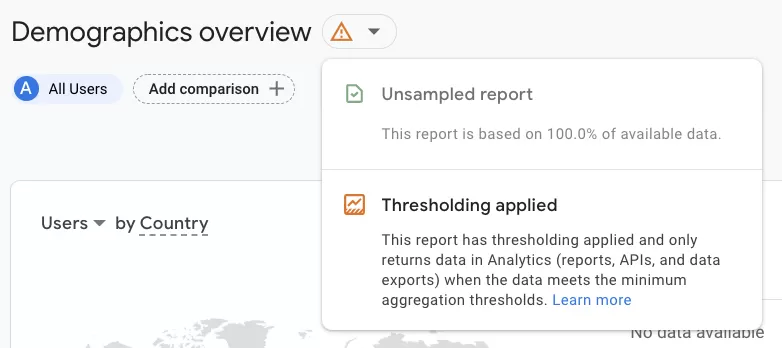
If you don’t see the icon at all, thresholds aren’t active for that particular view.
What Gets Affected
So what actually gets affected when data thresholds kick in?
Based on what I’ve seen, here’s what you can expect:
- Event and key event counts may be lower than expected — some data is simply hidden from the report.
- Channel data can show gaps or inaccurate breakdowns.
- Demographic dimensions like Age, Gender, and Interests may show no data at all
The data isn’t lost — it’s still collected. It’s just not displayed in that particular view because of the threshold.
How to Work Around It
If the report is applying data thresholds, you have two options:
- Select a longer time range — more data points may push you past the threshold.
- Wait — as you collect more traffic, the sample will grow, and GA4 may start showing demographic data naturally.
Final Words
Data thresholds can be frustrating, especially when you’re trying to dig into your audience data and the numbers just aren’t there. But they exist for a reason — user privacy. And honestly, in most cases, the best solution is simply to collect more data and give it time.
If you’ve run into a specific case where data thresholds are causing problems and the longer time range trick didn’t work, I’d love to hear about it. Drop a comment and share what you’ve found.