Update time: June 19, 2025
If you’ve ever set up a conversion in GA4 and wondered how to assign a value to it — or noticed that some conversions have a dollar amount while others don’t — you might have been confused about where that value actually comes from. Does GA4 pull it automatically? Do you have to set it manually? And what’s the difference between setting a value in the GA4 interface versus passing it through an event parameter?
Note: Google enamed Conversions to Key Events in GA4. I’ll use the new terminology throughout this guide.
That’s where GA4’s two key event value methods come in.
In this blog post, I’ll walk you through both approaches: the Default Key Event Value and the Event Parameter method. I’ll also show you a real example of setting up a custom key event with a fixed value using the Event Parameter approach.
Default Key Event Value
GA4 recently added the ability to set a default key event value directly in the interface. This is the simplest approach — you pick a key event and assign a fixed value to it without any code changes.
Here’s how to set it up. Say I want the `purchase` key event to have a default value of 100:
In GA4, click「Admin」——「Property settings」——「Data display」——「Events」:
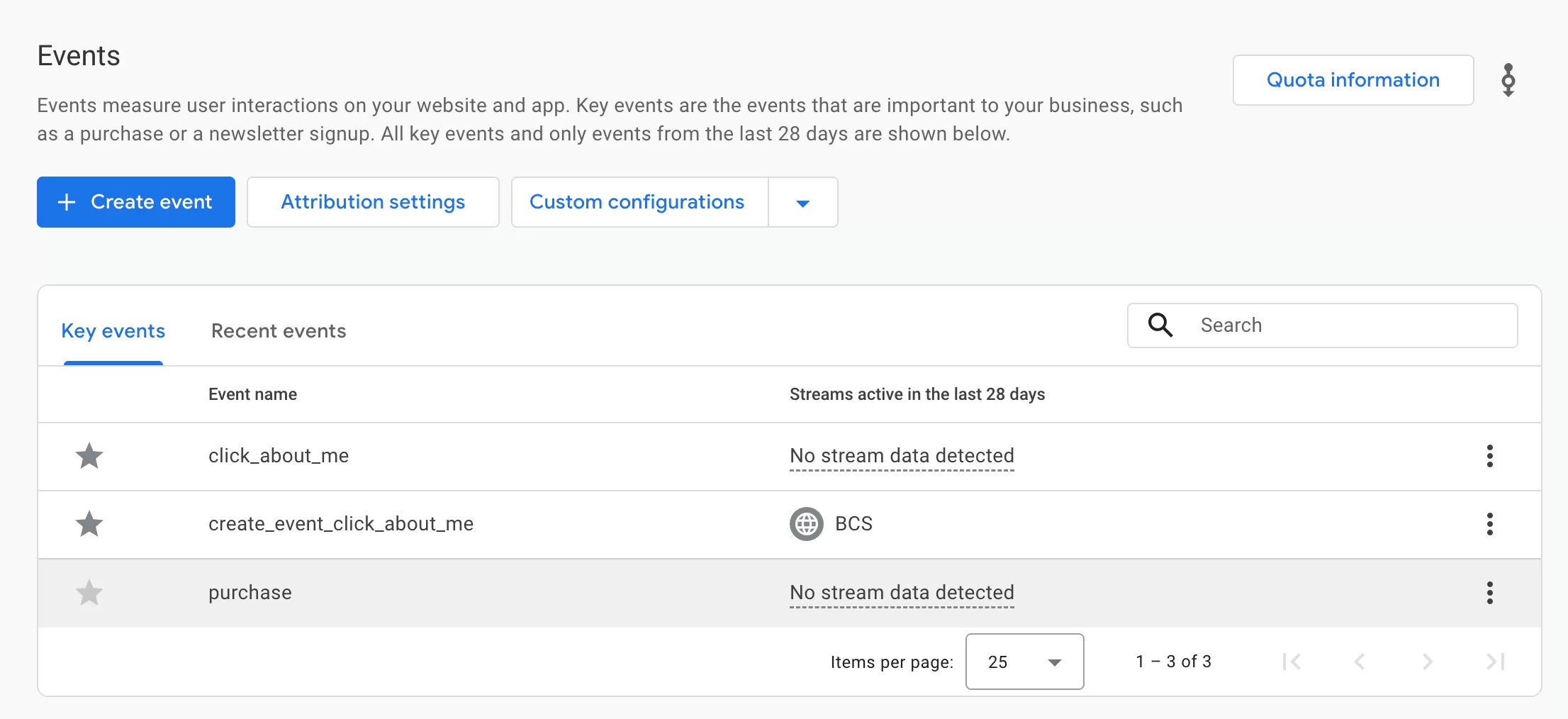
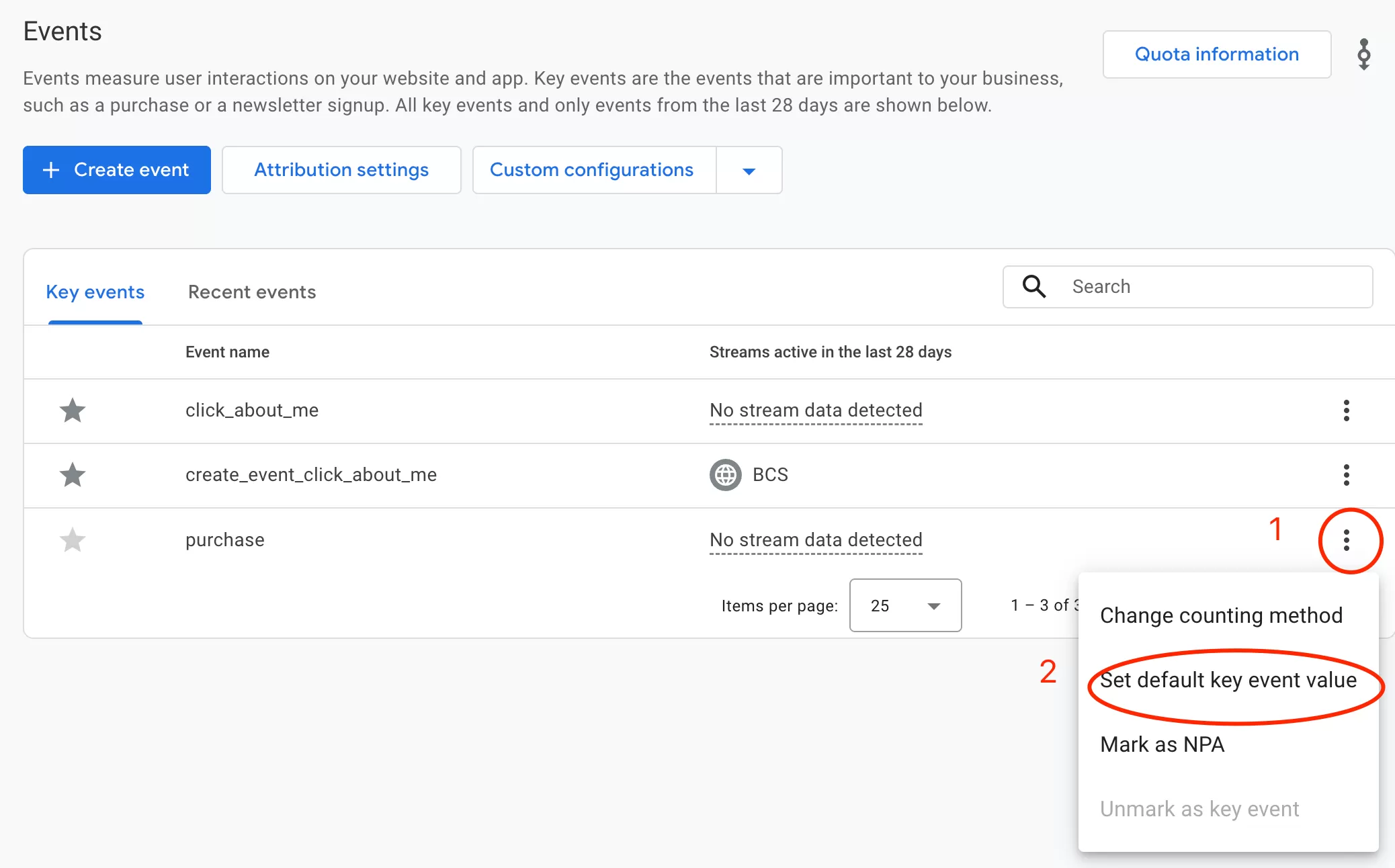
Find the `purchase` event and click the toggle/button on the right side
Then do the following settings:
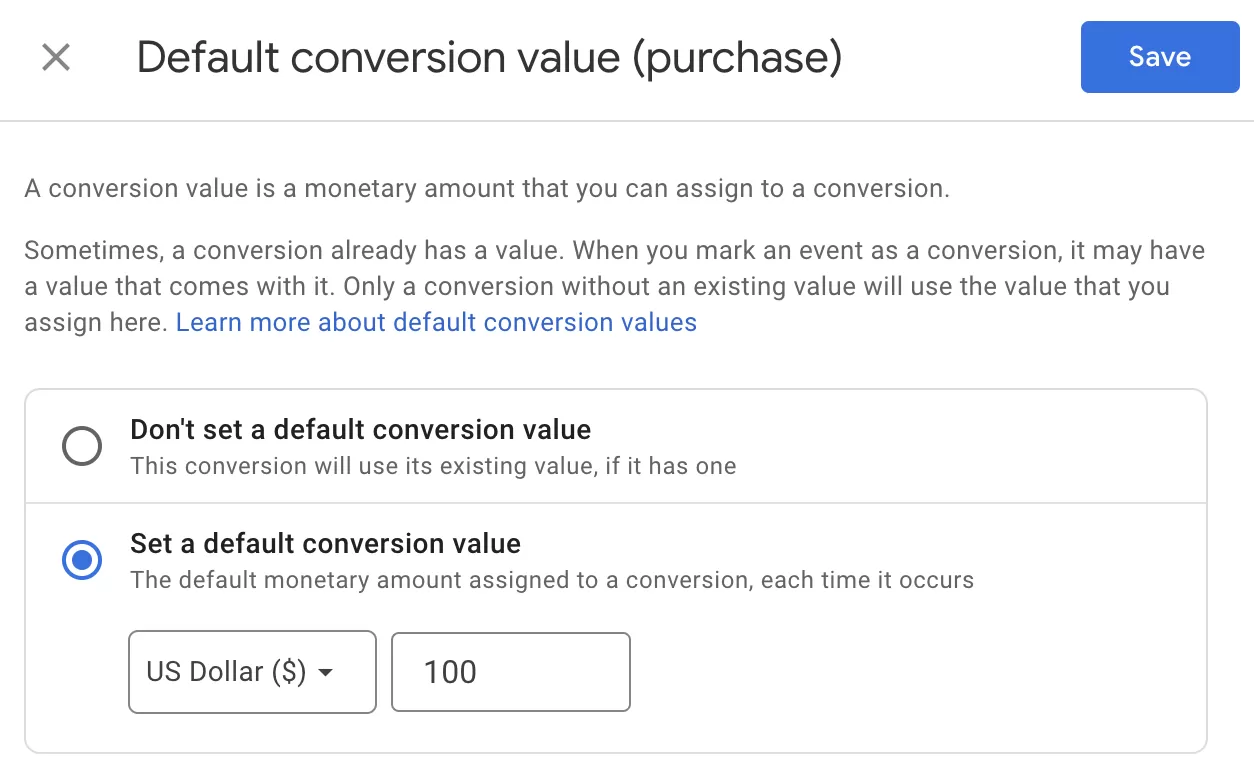
That’s it. Now every `purchase` key event will be recorded with a value of 100.
This method is useful when you want a quick, flat key event value and don’t need to track varying amounts per key event.
Event Parameter
The Event Parameter method is different. Instead of setting a fixed value in the GA4 interface, you pass the key event value as an event parameter when the event fires.
For example, the predefined purchase event in GA4 comes with a event parameter built in. When someone buys a product for $50, you pass value: 50 as part of the event. GA4 uses that parameter as the key event value automatically.

The advantage of this approach is obvious: each key event can have a different value based on what actually happened in the user’s session.
But here’s the thing — you can also use this method for custom events. Let me show you how.
Suppose I want to track visits to `https://www.bbccss.com/about-me.html` as a key event, and I want each visit to have a key event value of 88.
Step 1:Create Event
First, I need to create a custom event that fires when someone visits the About Me page.
In GA4,click 「Admin」——「Events」——「Custom configurations」——「Create events」——「Create」, customize the event name as “click_about_me”, and then set as follows:
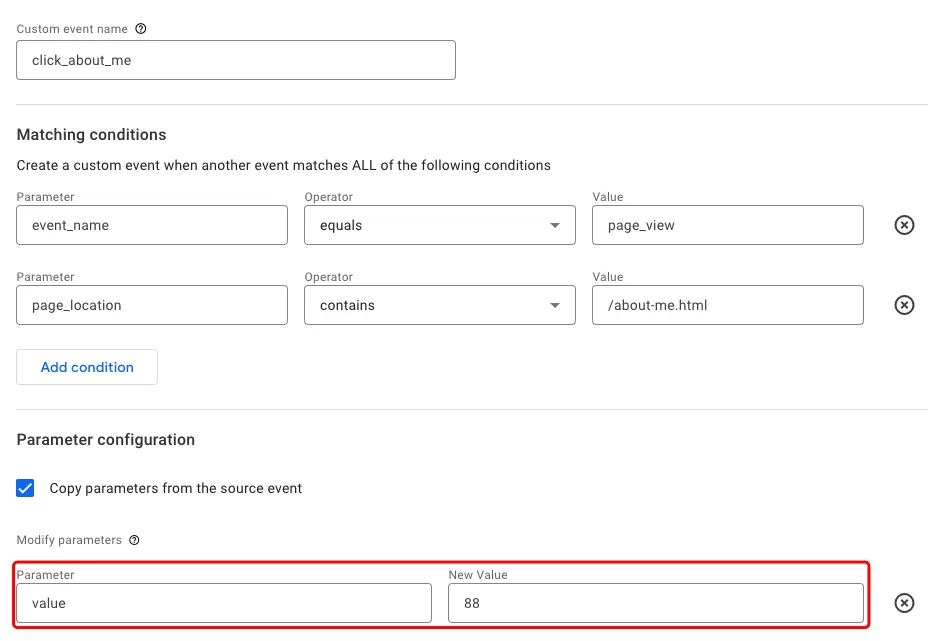
The event parameter is what carries the key event value. GA4 will use this value when recording the key event.
Step 2:Setting the Key Event
Now I need to tell GA4 that this new event is a key event.
In GA4, click 「Admin」——「Conversions」——「New conversion event」, and then enter the event name:
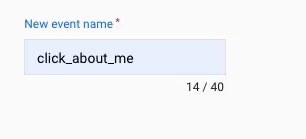
That’s it. The event is now a key event, and every time it fires, GA4 will record it with the value we set in the event parameter
Step 3:Verifying the Key Event Value
After setting up the key event, you’ll need to wait a bit. GA4 typically requires up to 24 hours to process and display new key events.
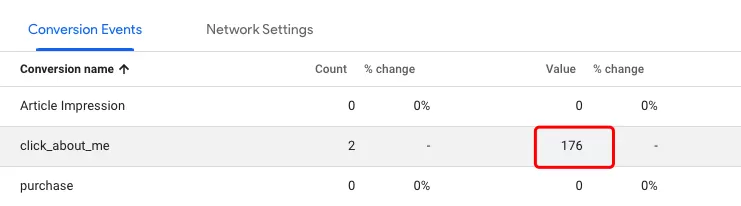
Once the data is available, you can check the key event value in your reports. For example, if the key event fires twice, you should see a total value of 176 (88 × 2).
If you don’t see data after 24 hours, check out this guide: New Event or Conversion data not in Google Analytics 4?
Final Words
Key event values in GA4 come in two flavors — the Default Key Event Value for quick, flat values, and the Event Parameter method for dynamic, event-specific amounts. Which one should you use?
- If all your key events have the same value (or you’re okay with a fixed amount), go with Default Key Event Value. It’s faster to set up and doesn’t require any event parameter configuration.
- If your key events vary in value — like purchases, donations, or bookings — use the Event Parameter method. It’s more flexible and gives you accurate reporting.
I hope this guide helped you understand how key event values work in GA4. If you have questions about a specific use case, feel free to leave a comment and I’ll do my best to help