You’ve set up your GA4 tracking, events are configured, and everything should be working. But is it actually sending the right data? Event names, parameters, e-commerce item IDs, user properties — there’s a lot that can go wrong between your tag configuration and what GA4 actually receives.
That’s where DebugView comes in. It’s a built-in real-time debugging tool in GA4 that shows you exactly what data your website or app is sending, event by event.
What Is DebugView?
DebugView is a real-time debugging report in GA4 that only shows data from devices that have debug mode enabled. It’s not a view of all live users — just the ones you’re testing with.
Through DebugView, you can verify:
- Event names — are they spelled correctly?
- Event parameters — are the right values being passed?
- User properties — are they firing as expected?
- E-commerce data — item IDs, prices, quantities, and other product data
One important thing to keep in mind: DebugView does not show all real-time user data. It only displays events from devices that have debug mode actively turned on. If you don’t see anything, it doesn’t mean your tracking is broken — you might just not be in debug mode yet.
Where to Find DebugView in GA4
In GA4. click 「Admin」——「Property Settings」——「Data Display」——「DebugView」.
Once you open it and have a device in debug mode, data will start appearing in real time.
Three Ways to Enable DebugView
GA4 doesn’t show data in DebugView by default — you need to enable debug mode first. Here are the three common methods.
Method 1: GTM Preview Mode (Recommended)
If your site uses Google Tag Manager to deploy GA4, this is the most reliable approach.
How to use it: In GTM, click Preview, enter your website URL, and the Tag Assistant will connect to your page. Any data sent by that device will now appear in DebugView.
Why I recommend it:
- No code changes needed
- Low risk of accidentally publishing debug settings to production
- It’s Google’s officially recommended method
Method 2: Google Analytics Debugger Extension
Install the Google Analytics Debugger Chrome extension.
How to use it: Click the extension icon until it shows On, then refresh the page. All data sent by the browser will now appear in DebugView.

Best for: Quick testing, or situations where you don’t have GTM access.
Method 3: Manually Set debug_mode
n your GA4 tag configuration (GTM or gtag.js), add debug_mode to Fields to Set and set it to true.
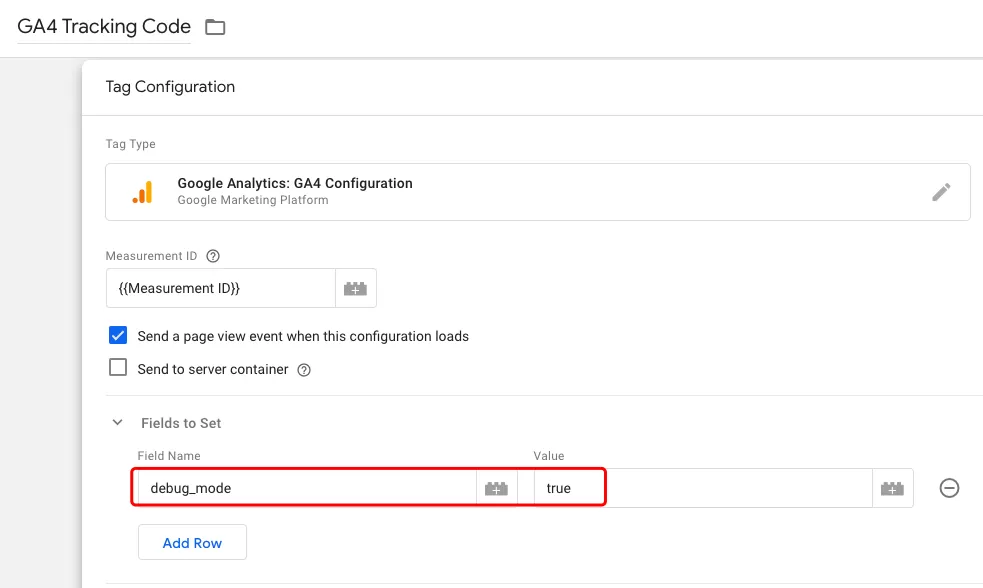
Heads-up: Be very careful with this method. If you accidentally publish this configuration to production, all real users will start sending debug data to DebugView, and your debug device list will become a mess of indistinguishable traffic. Only use this for short-term testing, and make sure to remove it before publishing.
DebugView Interface Explained
Once you’re in DebugView, the interface has five main sections.
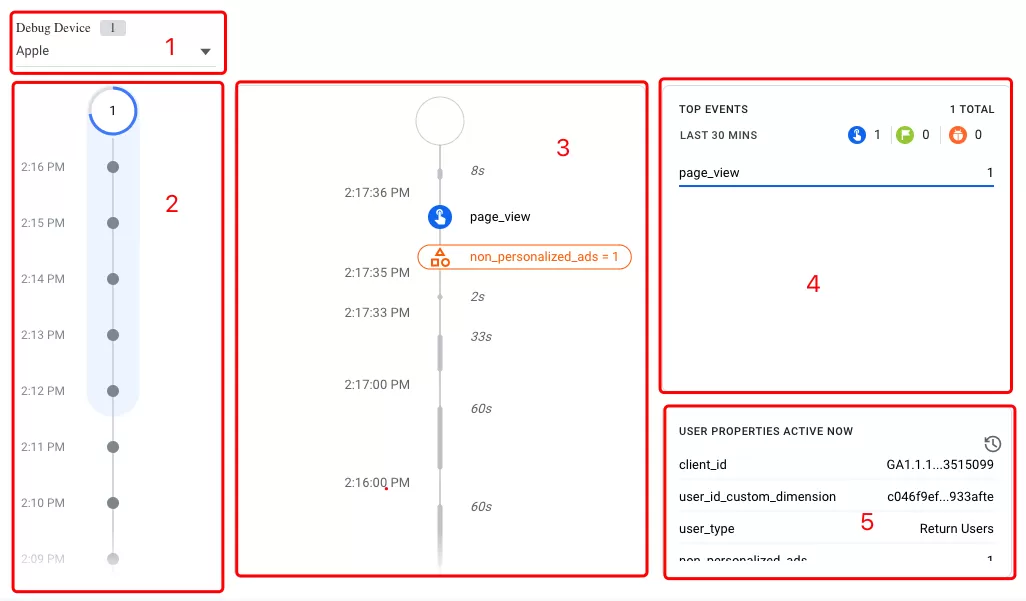
- Device Selector — shows the device currently in debug mode. If multiple people on your team are testing at the same time, use the dropdown to select your own device so you’re only looking at your own data.
- Minutes Stream — displays circles representing each of the last 30 minutes. The number inside each circle is the event count for that minute. Click any circle to drill into the seconds-level events.
- Seconds Stream — shows individual events from the past 60 seconds with timestamps. Click any event to inspect its parameters and user properties — this is where you confirm your tracking data looks correct.
- Top Events — summarizes the most frequently triggered events in the last 30 minutes. Good for a quick overview of what’s been firing.
- Current User Properties — shows the latest user property values for the selected device.
How to Debug with DebugView
Here’s the basic workflow I follow every time I need to verify tracking.
Step 1: Select your device
When you first enter DebugView, select your own device from the device selector. This isolates your test traffic from other developers’ or any stray debug data.
Step 2: Perform the test action
Go to your site and do whatever you’re testing — click a button, visit a page, add an item to the cart, whatever the event requires.
Step 3: Check the event parameters
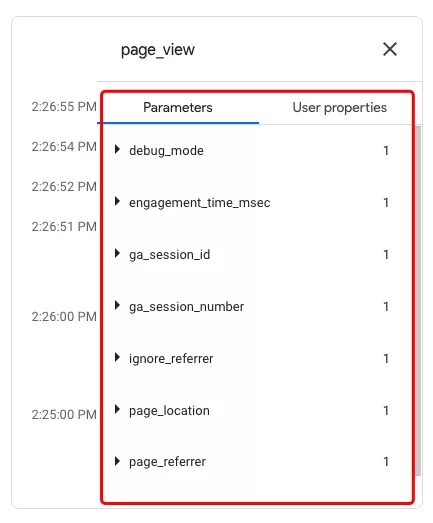
Back in DebugView, click the relevant circle in the Minutes Stream, then find your event in the Seconds Stream. Click it and inspect the event name, parameters, and user properties to confirm everything looks correct.
Click any circle at will, and the Seconds stream will be displayed on the right.
Common Issues and Fixes
I’ve run into most of these myself, so here are the ones I see most often and how to handle them.
Duplicate Events in DebugView
If you’re seeing multiple copies of the same event firing, here are the usual suspects:
- Duplicate tracking — GA4 is deployed more than once on the same page
- GTM firing triggers — the same tag is triggering from multiple rules
- Enhanced measurement conflicts — built-in tracking is sending an event that your custom tag also sends
- Erroneous triggers — other tags or conditions are accidentally firing the event
If you’ve ruled all of these out, it might be a bug on Google’s side. Wait for an update.
Wrong Price Display (e.g., 250 showing as 250000000)
This one looks alarming but it’s harmless. GA4 internally converts some floating-point values (prices, amounts) into integers for storage and processing efficiency. In DebugView, it shows the raw internal value rather than the human-readable number.
No action needed. The final reports will display the correct price. You can safely ignore this.
Too Many Devices in DebugView
If you open DebugView and see a huge list of devices, it usually means debug_mode was accidentally set to true and published to production. Every real user visiting your site is now sending debug data.
Fix: Remove debug_mode from your tags and republish.
No Data in DebugView
This is probably the most frustrating one. If GTM Preview connects fine, Network requests are sending, but DebugView shows nothing, here are the common causes:
- Data delay — DebugView can lag by 10-15 seconds. Wait a bit.
- Filters blocking test traffic — if you set up a filter that excludes your own IP or traffic, your debug data gets filtered out too.
- Browser extensions blocking GA4 — ad blockers or privacy extensions can interfere.
- System bug in the DebugView pipeline — it happens. Google’s debug chain sometimes breaks.
What to try:
- Refresh the page a few times
- Switch to a different debug method (try the Chrome extension instead of GTM Preview)
- Use the Network tab as a fallback to verify data is being sent
Testing Page A, Seeing Page B
If you’re debugging page A but DebugView shows events from page B, your site might be a SPA (Single Page Application) that triggered a virtual page navigation. The fix is to implement proper virtual pageview tracking so the correct page info is sent.
Final Words
DebugView is the most fundamental data validation tool for GA4 implementations. Combined with Tag Assistant and your browser’s Network tab, it forms the debugging workflow I use every single time. Get comfortable with it before you publish anything to production — it’ll save you from discovering broken tracking in your reports days or weeks later.