Update time: April 13, 2026
If you’ve ever opened your GA4 channel report and seen a chunk of traffic labelled “Unassigned,” you probably had the same reaction I did the first time: “Where did this come from, and why is it not in a real channel?”
You’re not alone. Unassigned is one of the most common — and most frustrating — things people encounter in GA4. The official documentation says it’s what GA4 uses when no channel rule matches the event data. That’s technically true, but it doesn’t help you figure out why it’s happening or what to do about it.
I spent quite a bit of time tracking down the real reasons behind Unassigned traffic across different setups. Some were obvious. Others took me days to reproduce. This article is the result of those experiments.
Let’s get into it.
Reason #1: UTM Parameters Don’t Match Channel Rules
This is the most common cause, and honestly, it’s the one I see most often when I audit other people’s GA4 setups. Your tracking is working fine — the problem is your naming conventions.
Here are real examples I’ve pulled from actual audits:
utm_source=Admin&utm_medium=Admin&utm_campaign=Admin
utm_source=BLOG&utm_medium=ELLA
utm_source=GA&utm_medium=AD_K
None of these values match GA4’s default channel grouping rules. GA4 doesn’t know where to put them, so it dumps them into Unassigned.
How to troubleshoot:
- In your channel report, filter for Unassigned traffic.
- Add First user source / medium as a secondary dimension.
- Look at the values. In most cases, you’ll immediately see the problem — it’s almost always a source or medium that doesn’t follow standard naming conventions.
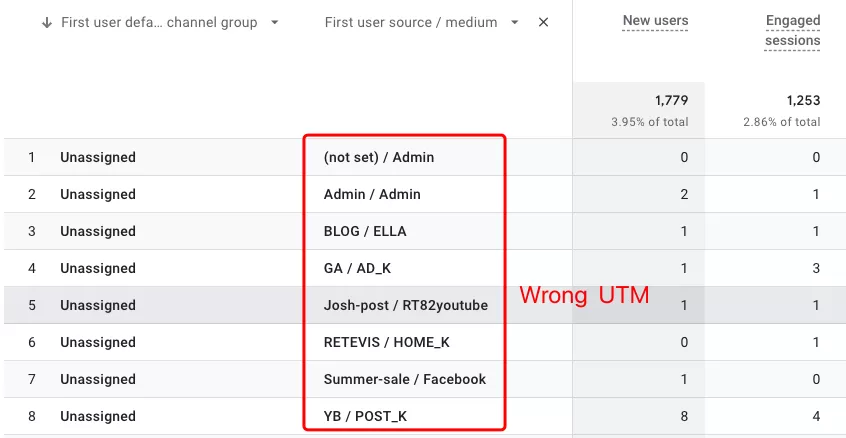
The fix isn’t a code change. It’s a naming convention change. Decide on standard UTM values that match GA4’s channel rules, and stick to them across all your campaigns.
Reason #2: Missing ga_session_id in Measurement Protocol
If you’re sending data to GA4 through the Measurement Protocol, you need to include ga_session_id in your payload. Without it, GA4 can’t associate the event with a session, and the traffic ends up as Unassigned.
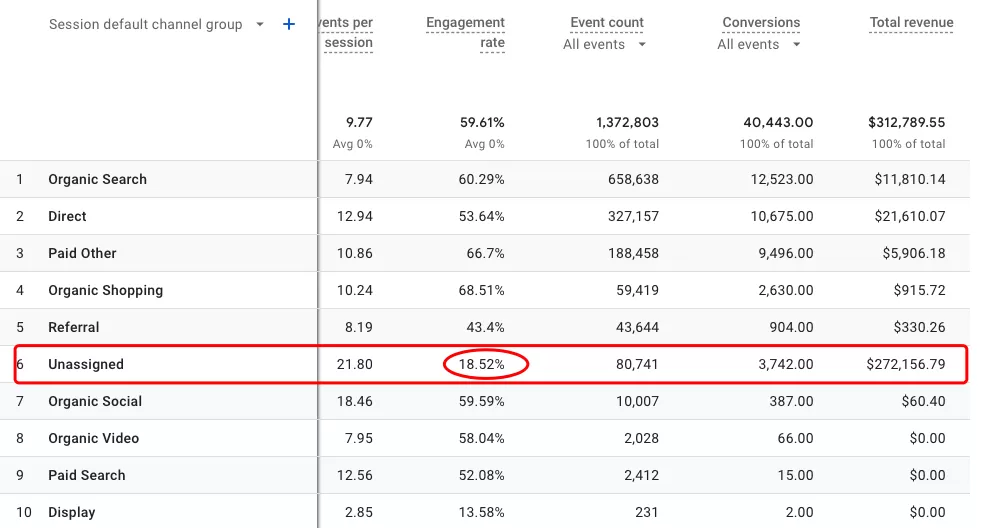
This one caught me off guard the first time I ran into it. I was sending server-side events, everything looked fine in the debugger, but the channel attribution was all wrong. Took me a while to realize I’d forgotten the session parameter.
The fix: Make sure every Measurement Protocol request includes ga_session_id as an event parameter. If you’re generating sessions server-side, generate and pass the session ID explicitly.
Reason #3: Missing session_start Event
Here’s something I learned the hard way. The session_start event isn’t just a polite notification — it’s the event that carries source, medium, and referrer attribution. If it doesn’t fire, GA4 receives events without any attribution data, and the session gets classified as Unassigned.
Missing session_start event is a pain in the a$$ for many of us, and tracking down why it’s missing can be tricky. Ad blockers, browser restrictions, incorrect GTM trigger configurations — I’ve seen all of them cause this.
How to troubleshoot:
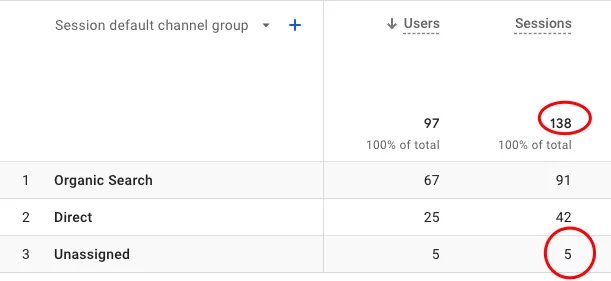
- Total Sessions: 138
- Unassigned Sessions: 5
- Expected session_start: 133
Go to your Events report and compare the numbers:
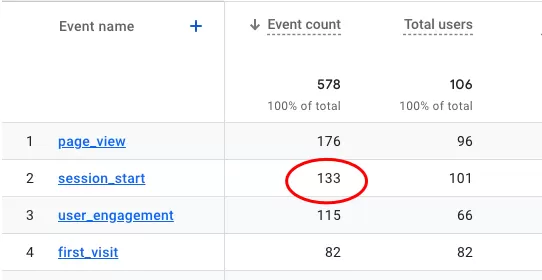
Note: Some sessions can trigger multiple session_start events. Over longer date ranges, this can cause slight discrepancies, so don’t panic if the numbers don’t line up perfectly. But a significant gap is worth investigating.
I don’t have a single magic fix for this one, unfortunately. The root cause varies by setup. But if you’re using GTM, check whether your GA4 config tag is firing correctly on every page, and make sure no other tag is overriding or blocking the session initialization.
Reason #4: Data Still Being Processed
This one is more of a false alarm than a real issue. When data is still under processing in GA4, channel attribution may not yet be finalized. During this window, you might see temporary Unassigned values that resolve on their own once processing completes.
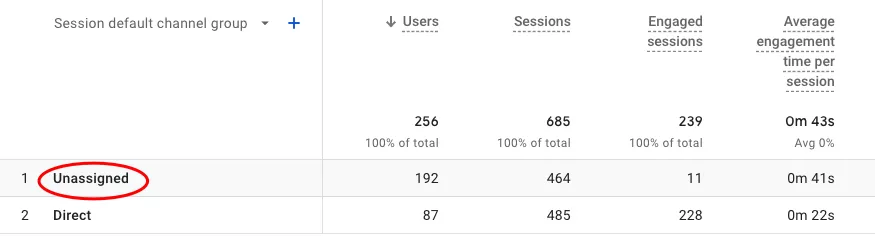
I’ve seen this mostly in the first few hours after a new property is set up, or after a large data import. If Unassigned shows up in the most recent hour or two but disappears in yesterday’s data, processing delay is probably the cause.
The fix: Wait 24-48 hours and check again. If the Unassigned traffic is still there after that, start investigating the other reasons on this list.
Reason #5: Multiple Google Tags Installed
This one is surprisingly common. If you have multiple Google Tags (or multiple GA4 configurations) firing on the same page, they can cause session conflicts. GA4 gets confused about which tag “owns” the session, and parts of the session end up without proper attribution.
The fix: If you need to run multiple tags, use cookie_prefix to add a prefix to the cookie names. This separates the session storage for each tag and prevents conflicts.
Reason #6: Server-Side Tracking Causes ID Conflicts
If you’ve set up server-side tagging, this one’s for you. Server-side tracking creates an FPID (First-Party Identifier) cookie. But if your website already has the standard _ga cookie from client-side tracking, you can end up with two IDs within a single session. GA4 can only properly attribute one of them — the other lands in Unassigned.
I ran into this on one of my own setups and spent way too long debugging it. The fix is simple once you know where to look.
The fix: In your GTM server-side client configuration, make sure to enable Migrate from JavaScript-managed client ID. This tells the server-side tag to recognize the existing _ga cookie and use it instead of creating a conflicting FPID.
Final Words
Unassigned traffic is one of those GA4 topics that looks simple from the outside — “just traffic that doesn’t match a rule” — but has a surprisingly long tail of causes. I’ve covered the six I see most often, but I will not pretend this list is complete. There are still many unknowns.