The first time you open the default channel report in GA4, it can be confusing. The groupings look different, the rules feel different, and suddenly you’re questioning whether your traffic is being sorted correctly.
You’re not alone. I’ve been through this, ran a bunch of experiments, and this guide is the result. Let’s get into it.
First: What Actually Is a Default Channel Grouping in GA4?
This seems basic, but it’s worth stating clearly because the terminology trips people up.
A default channel grouping is Google’s pre-built set of rules for categorizing your traffic. Each channel (Paid Search, Organic Social, Display, etc.) has a specific definition — a combination of source, medium, campaign, or platform-specific parameters — that GA4 checks when data comes in.
GA4 applies these rules automatically. You don’t need to configure anything. But here’s the catch: the rules are rigid. If your data doesn’t match them perfectly, GA4 still assigns a channel — it just might not be the right one.
There’s also a first user version of this: first user primary channel group. Same rules, different scope. The regular channel grouping applies to every session. The first user version applies only to the first session a user ever had. That’s what you see in first user primary channel group — and yes, first user SA360 source / medium is the companion dimension that shows you the specific source/medium pair from that user’s first visit if it came through SA360.
What Channels Are Included in the Default Grouping?
Here are all the default channels GA4 ships with:
| Channel | Channel Group | Definition |
|---|---|---|
| Google Ads traffic | Paid Search | Traffic is Google Ads AND Google Ads ad network type is one of (“Google Search”, “Google Partners”) |
| Paid Video | Traffic is Google Ads AND Google Ads ad network type is one of (“YouTube Search”, “YouTube Videos”) |
|
| Display | Traffic is Google Ads AND Google Ads ad network type is one of (“Google Display Network”) |
|
| Cross-network | Traffic is Google Ads AND Google Ads ad network type is one of (“Cross-network”) Cross-network includes Performance Max and Smart Shopping. |
|
| Paid Social | Traffic is Google Ads AND Google Ads ad network type is one of (“Social”) |
|
| Display & Video 360 traffic | Display | Traffic is DV360 AND DV360 creative format is one of (“Standard”, “Expandable”, “Native site square”, “Backdrop”, “Templated app install interstitial”, “Deprecated”, “Native app install”, “Native app install square”, “Native site”, “Templated app install”, “Lightbox”) |
| Paid Video | Traffic is DV360 AND DV360 creative format is one of (“Native video”, “Video”, “Templated app install video”, “Flipbook”) |
|
| Audio | Traffic is DV360 AND DV360 creative format is one of (“Audio”) |
|
| Paid Other | Traffic is DV360 AND DV360 creative format is one of (“Publisher hosted”, “Tracking”, “Unknown”) |
|
| Search Ads 360 traffic | Paid Search | SA360 engine account type is one of (“bing”, “yahoo gemini”, “yahoo.jp”, “baidu”, “admarketplace”, “naver”, “360.cn”, “yandex”) |
| Paid Social | SA360 engine account type is one of (“facebook”, “twitter”) | |
| Manual traffic | Direct | Source exactly matches direct AND Medium is one of (“(not set)”, “(none)”) |
| Cross-network | Campaign Name contains “cross-network” Cross-network includes Performance Max and Smart Shopping. |
|
| Paid Shopping | (Source matches a list of shopping sites OR Campaign Name matches regex ^(.*(([^a-df-z]|^)shop|shopping).*)$)AND Medium matches regex ^(.*cp.*|ppc|paid.*)$ |
|
| Paid Search | Source matches a list of search sites AND Medium matches regex ^(.*cp.*|ppc|paid.*)$ |
|
| Paid Social | Source matches a list of social sites AND Medium matches regex ^(.*cp.*|ppc|paid.*)$ |
|
| Paid Video | Source matches a list of video sites AND Medium matches regex ^(.*cp.*|ppc|paid.*)$ |
|
| Display | Medium is one of (“display”, “banner”, “expandable”, “interstitial”, “cpm”) | |
| Organic Shopping | Source matches a list of shopping sites OR Campaign Name matches regex ^(.*(([^a-df-z]|^)shop|shopping).*)$ |
|
| Organic Social | Source matches a regex list of social sites OR Medium is one of (“social”, “social-network”, “social-media”, “sm”, “social network”, “social media”) |
|
| Organic Video | Source matches a list of video sites OR Medium matches regex ^(.*video.*)$ |
|
| Organic Search | Source matches a list of search sites OR Medium exactly matches organic |
|
| Source = email \| e-mail \| e_mail \| e mail OR Medium = email \| e-mail \| e_mail \| e mail |
||
| Affiliates | Medium = affiliate | |
| Referral | Medium = referral | |
| Audio | Medium exactly matches audio | |
| SMS | Medium exactly matches sms | |
| Mobile Push Notifications | Medium ends with “push” OR Medium contains “mobile” or “notification” |
These 18 channels cover most scenarios. But “most” is the key word — there are channels that don’t belong here, and you’ve probably noticed them in your reports.
The Golden Rule: UTM Parameters and Channel Assignment
Let me give you a concrete example so you can see exactly how this plays out.
Say you have these two links pointing to the same page:
- https://www.bbccss.com/index.html?utm_source=facebook&utm_medium=cpc&utm_campaign=summer-sale
- https://www.bbccss.com/index.html?utm_source=facebook&utm_medium=social&utm_campaign=summer-sale
Same source, same campaign. The only difference is the medium. But GA4 will classify them into completely different channels:
- First link (medium=cpc): Paid Social — because Facebook is in the social sites list AND cpc matches the paid medium regex.
- Second link (medium=social): Organic Social — because social is an organic social medium.
See how powerful (and dangerous) that medium parameter is? A single character can change whether GA4 thinks the traffic is paid or organic. That’s why getting your UTM strategy right matters so much.
The Mysterious Case of Unassigned Traffic
If you’ve spent any time in GA4, you’ve probably seen Unassigned traffic and wondered where it came from. I ran quite a few experiments on this, and here’s what I found.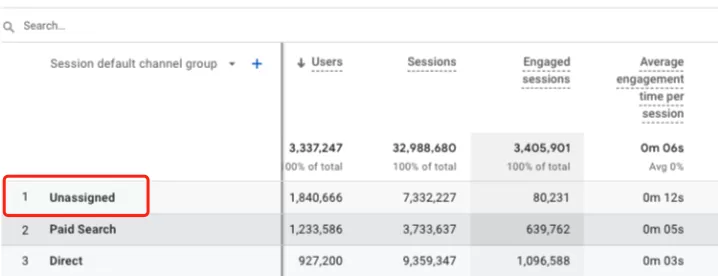
Unassigned is basically GA4’s catch-all: it’s the value used when no other channel rule matches the event data. That’s the official explanation, but let me show you the three most common reasons it happens.
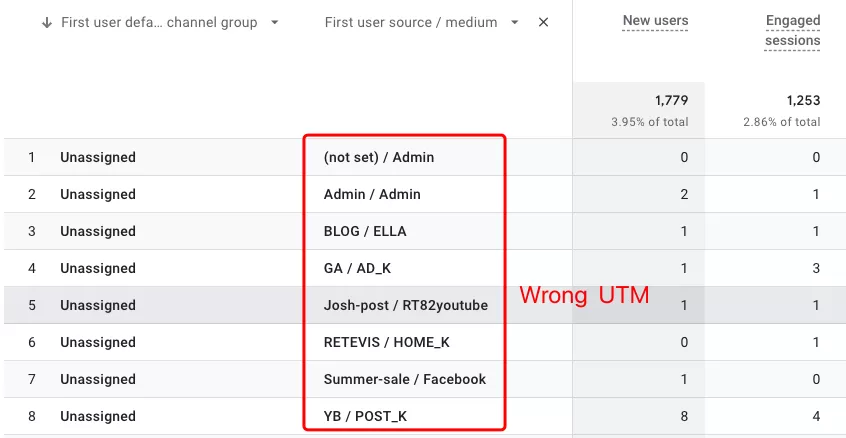
Reason #1: UTM Parameters Don’t Match Any Channel Rules
This is the most common one. If your UTM parameters aren’t recognized by any channel definition, GA4 has nowhere to put them. Here are some real examples I’ve seen:
- utm_source=Admin&utm_medium=Admin&urm_campaign=Admin
- utm_source=BLOG&utm_medium=ELLA
- utm_source=GA&utm_medium=AD_K
None of these match the expected source/medium patterns, so they all land in Unassigned.
How to diagnose it: Filter out Unassigned, then add “First user source/medium” as a secondary dimension. You’ll see exactly which sources and mediums are causing the problem. eg:
Reason #2: Measurement Protocol Is Missing ga_session_id
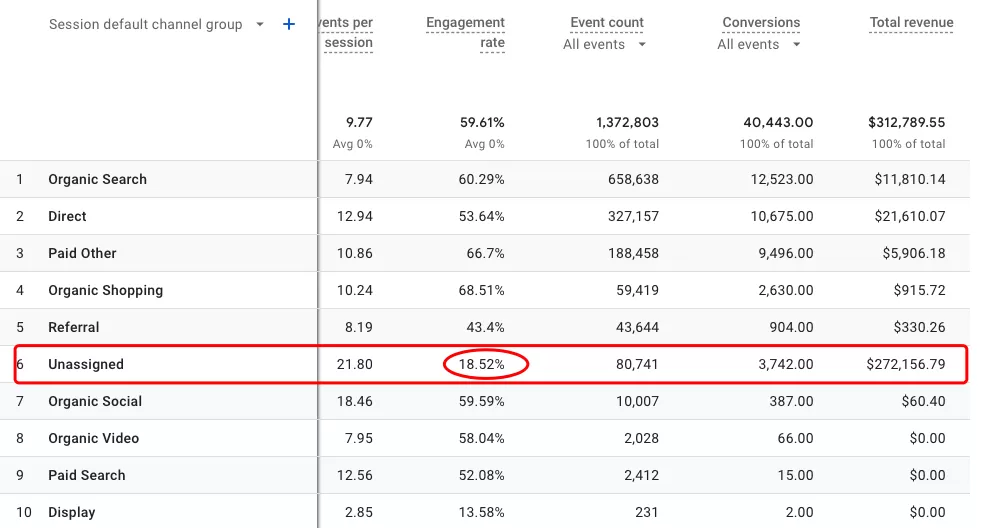
If you’re sending data through the Measurement Protocol without the ga_session_id parameter, that traffic will be classified as Unassigned. I’ve also noticed that in these cases, some engagement metrics tend to be lower. Not entirely sure why — but it’s worth keeping an eye on.
Reason #3: session_start Event Is Lost
Here’s the thing: when a session begins, GA4 sends a session_start event, and the UTM information is attached to that event. If the session_start event doesn’t fire (or doesn’t fire correctly), the UTM parameters never get set, and the traffic lands in Unassigned.
What About “(other)”?
You might also see “(other)” showing up in your channel reports. This is different from Unassigned. (other) is what GA4 uses when it hits cardinality limits — basically, there are too many unique values, and it aggregates them into a single row.
I will not cover all the possible scenarios for “(other)” here (there are still many unknowns), but generally, if you see a lot of “(other)”, it’s worth reviewing your data volume and how many unique combinations you’re sending to GA4.
Final Words
Alright, that covers the essentials of GA4 default channel groupings. I hope this guide helped you make sense of how your traffic gets sorted — and more importantly, why it sometimes doesn’t get sorted the way you expect.
So, while I hope that at least some of the examples and explanations in this guide helped you, I hope even more that you can share your learnings. The more we share, the better we’ll all get at making sense of GA4 channel reporting.