Update time: January 12, 2025
If you’ve recently set up GA4 and opened the Events report expecting it to be empty until you create tags, you might have noticed something strange — GA4 is already tracking stuff. Without any additional configuration.
That’s where automatically collected events come in. In this guide, I’ll walk you through what they are, how they work, and exactly which events GA4 collects out of the box for websites and mobile apps. No custom code needed.
What Are Automatically Collected Events?
Automatically collected events are events that GA4 starts recording the moment you connect a data stream — no configuration, no custom code, no extra work on your end.
Here’s how it works: once you install the Google tag (gtag.js), deploy GA4 through GTM, or integrate the Firebase SDK for a mobile app, GA4 begins collecting these events in the background. You don’t need to create tags, write JavaScript, or ask a developer for help.
These events show up in the Events report in GA4 right away. They give you essential information about user activity — think page views, sessions, first visits — without requiring any custom implementation.
Categories of Automatically Collected Events
Here’s the thing: the set of automatically collected events is different for websites versus mobile apps. GA4 is smart about what it tracks depending on the platform.
Web Events
For websites, GA4 automatically collects the following core events:
| Event | Automatically triggered… | Parameters |
|---|---|---|
| first_visit | the first time a user visits a website or launches an Android instant app with Analytics enabled | |
| page_view | each time the page loads or the browser history state is changed by the active site | page_location (page URL), page_referrer (previous page URL), engagement_time_msec |
| session_start | when a user engages the app or website, A session ID and session number are generated automatically with each session and associated with each event in the session. | |
| user_engagement | when the app is in the foreground or webpage is in focus for at least one second. | engagement_time_msec |
Note: Although page_view is technically classified as an Enhanced Measurement event, it’s enabled by default and cannot be disabled independently. As a result, it’s typically treated as an automatically collected event in practice.
Important: Google may add, remove, or modify automatically collected events over time. Always check the latest official GA4 documentation for the most up-to-date list.
App Events
For mobile apps, GA4 collects a much broader set of events out of the box. Here’s what you get:
- Advertising events (AdMob)
- App lifecycle events
- In-app purchase events
- Subscription events
- Firebase Dynamic Link events
- Firebase Cloud Messaging (FCM) notification events
- Screen view events
- Session events
- User engagement events
Some of the most commonly used app events include:first_open、session_start、screen_view、user_engagement、in_app_purchase、app_update、app_exception、os_update、notification_open
Keep in mind that the available event parameters vary depending on the event — not every parameter is available for every event.
Default Event Parameters
As you saw above, each automatically collected event comes with its own event-specific parameters. But here’s something a lot of people miss: every GA4 event — not just automatically collected ones — also includes a set of default event parameters that GA4 populates automatically.
Here are the common default parameters you’ll see:
| Web | APP | |
|---|---|---|
| Default Event Parameters |
|
|
How to View Automatically Collected Events in GA4
To see these events in action:go to「Reports」——「User Lifecycle」——「User engagement & retention」——「Events」,there, you’ll find all automatically collected events alongside any recommended or custom events you’ve implemented:
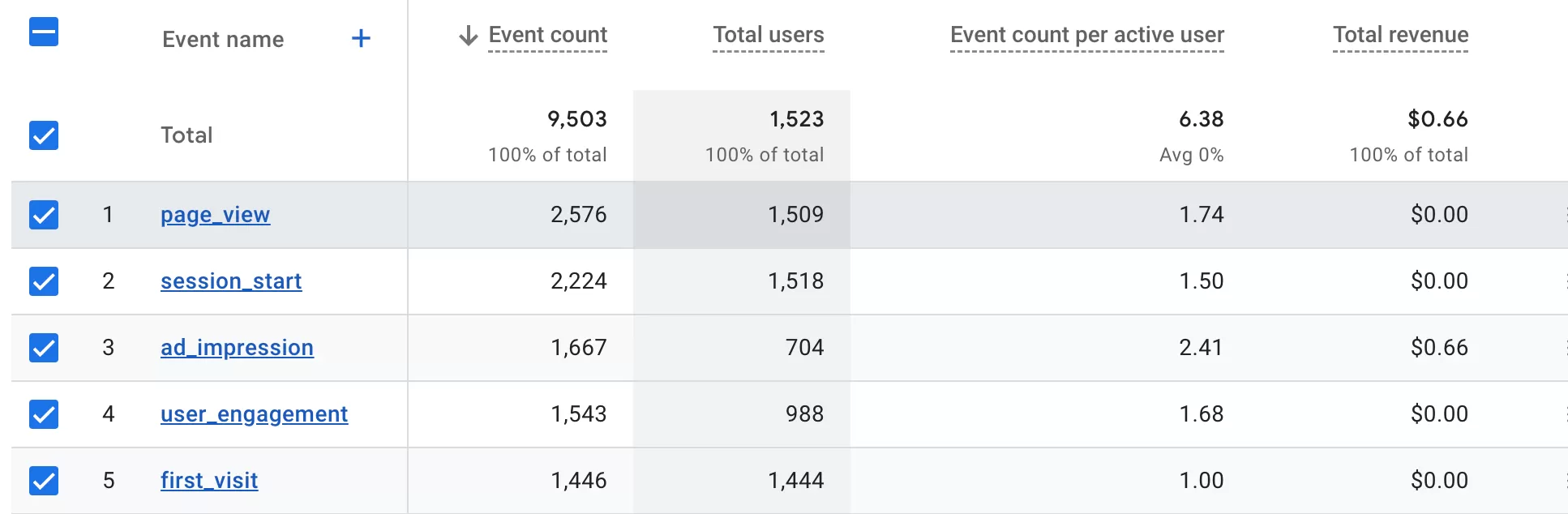
That’s it. No filters, no segments, no extra setup.
Final Words
Automatically collected events are one of those things that make GA4 feel like magic at first — and overwhelming once you start asking “wait, where did all these events come from?” My goal with this guide was to demystify exactly what GA4 collects out of the box and what triggers each event.
Here’s what I want you to remember: GA4 gives you a solid foundation of tracking without any work on your end. first_visit, session_start, page_view, and user_engagement cover the essentials for websites, while mobile apps get a much richer set including purchases, app lifecycle, and screen views. You can build on top of this foundation with custom events later — but you’re never starting from zero.
I hope this guide helped you make sense of automatically collected events. If you have questions about a specific event or parameter that I didn’t cover here, feel free to leave a comment and I’ll do my best to help.