Updated: January 12, 2025
You’ve probably heard that GA4 can track things like scrolls, outbound clicks, file downloads, and form submissions automatically — no code required. But if you’ve ever opened your Web Data Stream settings and seen all those toggles, you might have wondered: what exactly does each one track? And are they reliable?
That’s where Enhanced Measurement comes in.
In this guide, I’ll walk you through everything you need to know about Enhanced Measurement events in GA4 — what they are, how they work, all seven event types, and where you should be cautious before relying on them.
What Are Enhanced Measurement Events?
Enhanced Measurement events are built-in events that you can enable directly from your Web Data Stream settings in GA4. No GTM, no custom code, no asking a developer to add dataLayer pushes.
Once you flip the toggle, the Google tag automatically starts sending these events to GA4. That’s it.
Key Things to Know
Before we dive into the details, here are two important things:
- Enhanced Measurement is enabled by default for new GA4 web data streams. If you created a property recently, it’s probably already tracking Enhanced Measurement events without you doing anything.
- Personally identifiable information (PII) must never be collected through Enhanced Measurement or any other GA4 event. Google is strict about this, and for good reason.
Types of Enhanced Measurement Events
GA4 currently supports seven types of Enhanced Measurement events for websites. Let’s go through each one.
Page Views
Tracks page views whenever a page loads or the browser history changes (for example, in a Single-Page Application).
- Event Name:page_view
- Event Parameters:page_location 、page_referrer
GA4 includes built-in support for virtual page tracking, which means it can detect route changes in most Single-Page Applications (SPAs) without additional code.
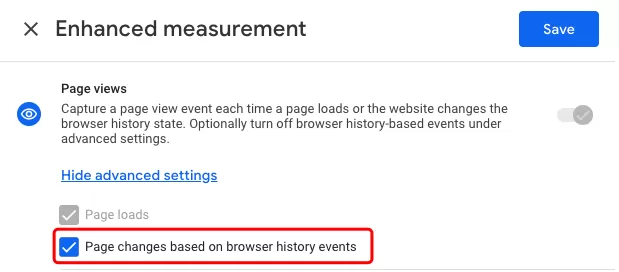
One thing to keep in mind: although page_view appears in the Enhanced Measurement settings, it cannot be disabled independently — it’s a core GA4 event. You’re getting it whether you like it or not.
Scrolls Tracking
Tracks when a visitor reaches approximately 90% of the page height for the first time.
- Event Name:scroll
- Event Parameters:No parameters
Note: The scroll event is triggered only once per page, not every time the user scrolls. So if someone scrolls to 90%, then back up, then down again — you’ll only get one event.
Outbound Clicks
Tracks clicks on links that navigate users away from your current domain.
- Event Name:click
- Event Parameters:link_classes、link_domain、link_id、link_url、outbound (boolean)
This is one of the most useful Enhanced Measurement events, especially if you’re tracking affiliate links or external references.
Site Search
Tracks searches performed using your website’s internal search feature.
By default, GA4 detects search terms from one of the following URL query parameters: q、s、search、query、keyword. You can customize this list by adding up to 10 query parameters.
For example, this URL will be tracked automatically:
https://example.com/search?q=analyticsBut here’s the catch: URLs that use path-based search, like:
https://example.com/search/analytics- Event Name:view_search_results
- Event Parameters:search_term
Video Engagement
Tracks interactions with embedded YouTube videos that have the YouTube IFrame API enabled.
- Event Name:video_start、video_progress、video_complete
- Event Parameters:video_current_time、video_duration、video_percent、video_provider、video_title、video_url visible (boolean)
I’ve covered YouTube video tracking in more detail in a separate post if you need deeper implementation guidance.
File Downloads
Tracks when users click links to download files with supported extensions.
Supported extensions include: pdf|xlsx?|docx?|txt|rtf|csv|exe|key|pp(s|t|tx)|7z|pkg|rar|gz|zip|avi|mov|mp4|mpe?g|wmv|midi?|mp3|wav|wma
- Event Name:file_download
- Event Parameters:file_extension、file_name、link_classes、link_domain、link_id、link_text、link_url
If you need more control over file download tracking (like filtering specific file types or tracking downloads from JavaScript triggers), I’ve written a dedicated guide on how to track file downloads in GA4.
Form Interactions
Tracks when users begin filling out or submit a form on your site.
- Event Name:form_start、form_submit
- Event Parameters:form_id、form_name、form_destination、form_submit_text
Now, here’s where I need to be honest with you. Although convenient, Form Interactions isn’t always reliable.
Here’s why: some third-party scripts — like the Facebook Pixel (Meta Pixel) — can trigger false form events because they submit data using HTML forms in the background. As a result, GA4 may incorrectly record form_start or form_submit events that never actually happened from a user perspective.
If your website uses Meta Pixel or similar marketing tools that manipulate forms in the background, I’d recommend implementing custom form tracking with GTM instead. It’s more work upfront, but the data will be much more accurate.
Key Takeaways
- Enhanced Measurement automatically tracks common website interactions without requiring custom code.
- New GA4 web properties have Enhanced Measurement enabled by default.
- GA4 currently supports seven built-in Enhanced Measurement event types.
- Some features, such as Form Interactions and Site Search, may require additional validation to ensure accurate data collection.
- For more advanced tracking requirements, Google Tag Manager provides greater flexibility and control.
Final Words
Enhanced Measurement is one of those features that makes GA4 feel genuinely useful right out of the box. You get page views, scrolls, outbound clicks, file downloads, and more — all without writing a single line of code. For a quick setup, it’s hard to beat.
But don’t get me wrong: it’s not perfect. Form Interactions can give you false positives if you’re running Meta Pixel, and path-based site search won’t be picked up automatically. The key is knowing where Enhanced Measurement works well and where you should invest in custom tracking instead.
I hope this guide helped you understand what Enhanced Measurement events do and which ones you can trust. If you have questions about a specific event type or use case, feel free to leave a comment and I’ll do my best to help.